
Holst's War
With composer Gustav Holst in Salonica and Constantinople as he served with the YMCA

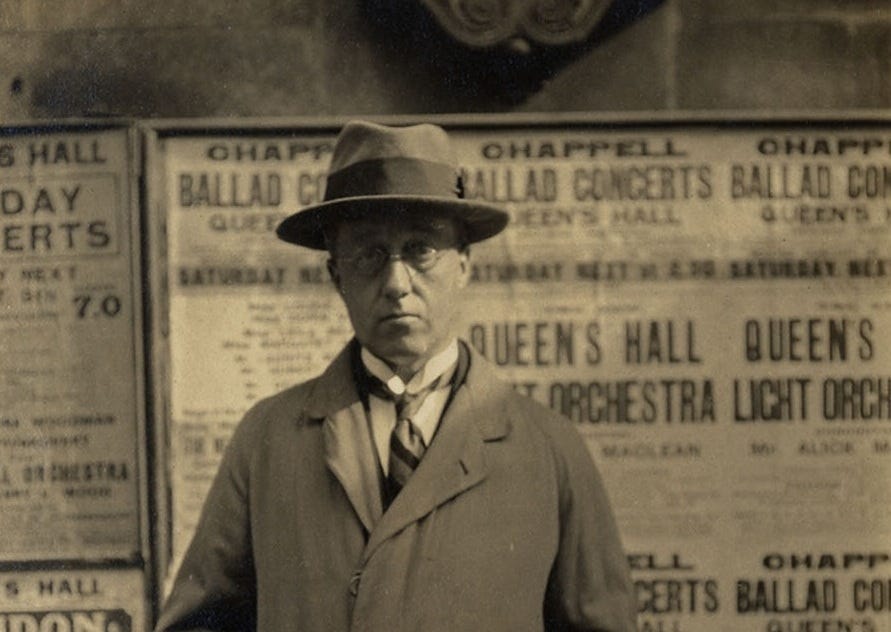
For Gustav von Holst, his war began quietly. Three months earlier he had composed the first of his ‘Seven Pieces for Large Orchestra’, a so-called ‘mood picture’ that became known to the world as Mars, the first of his Planets movements. It was to be a premonition of the ‘bringer of war’.
Composing in Thaxted, Essex while teaching music at St Paul’s Girls School and as director of music at Morley College, both in London, von Holst lived a life surrounded by his music. Following the outbreak of war he volunteered for service but was rejected owing to his short-sightedness, neuritic right hand (which had also prevented him becoming a proficient piano player), and bad digestion. Aged 40 and married with a child, there was little expectation he should serve.
However, saddled with a German surname through his great-grandfather who had emigrated to England in 1802, he quickly came under suspicion. Tucked away with his music, speculation became rife in the Thaxted community that he was a German spy and disloyal to the British cause. Unable to fight, he could do little to dissuade the locals, even when the authorities had quickly concluded any stories were mere paranoia.
von Holst spent the next two years committing to his composition and teaching, completing all movements of the Planets by 1916. His music also became his channel for service, organising charitable concerts to support the war effort.
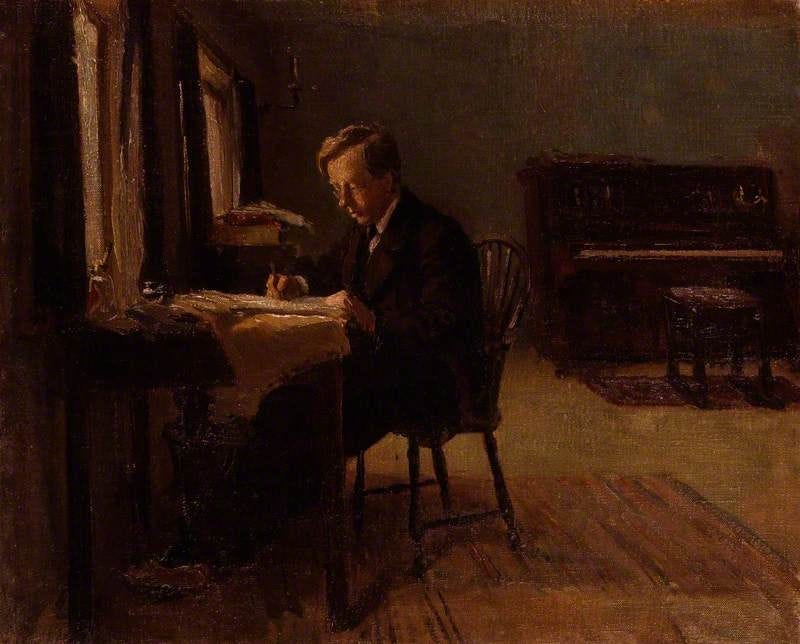
Once conscription was introduced in 1916 it became much harder for von Holst to maintain his musical groups. By October he was complaining that the Morley College choir numbered 50 women to only 2 men, of which ‘50 per cent of the men cannot sing!’
Still, he persisted with endeavours to entertain the home front. His Whitsun festivals proceeded at Thaxted, bringing out his London students to perform the works of Purcell, Vittoria, Lassus and Palestrina in the rural church, and later the first performance of his own ‘Three Festival Choruses’, written specifically for Thaxted.
At the same time, he was seeking other ways to fulfil his desire to serve his country and the war effort. Eventually, he made contact with the YMCA and applied to an ideal role in the Music Section of their Education Department. Despite being an expert in this work, he was rejected from his first posting. His Germanic surname still posed a problem and the YMCA prevented him from working at an internment camp in Holland lest ‘von Holst’ disturb the Allied internees.
After four years of rejections, Gustav von Holst came to a compromise, suggested to him by Percy Scholes, music critic and organising secretary of the Music Section. He would drop the ‘von’ from his surname, a prefix ironically added to the Holst name by Gustav’s great-grandfather to add prestige to the family in England.
Now just Gustav Holst, he received a year’s contract with the YMCA and resigned as musical director at Morley from the Summer Term 1918, accepting the condition that his position may not be open to him on his return. His great friend Henry Balfour Gardiner gifted him a private professional performance of the Planets as a goodbye gift, the first time he heard it performed by a full orchestra. Conducted by Adrian Boult, the Queen’s Hall Orchestra and the St Paul’s Girls School choir performed the suite in full, to a rapturous reception from the audience, who included many of Holst’s friends and admirers, including Sir Henry Wood.
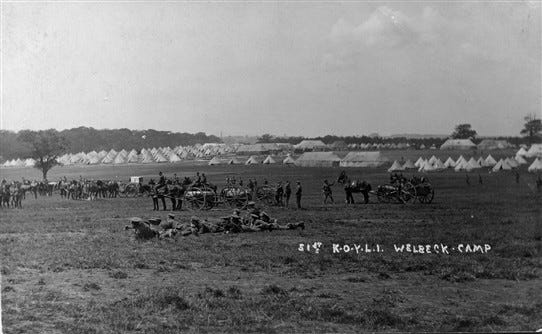
This reception still ringing in his ears, he was then off to war. First, he went to Welbeck Camp in Nottinghamshire, where he was quickly introduced to the reality of wartime conditions. The training camp had been set up soon after the outbreak on the requisitioned land of Welbeck Abbey to the south of Worksop. By Autumn 1918, the camp was submerged in flood water and the mud inescapable. Holst wrote his correspondence from the YMCA cookhouse, which he described as ‘the driest part of camp’ in that ‘only 3/4 of the ground is flooded so far.’
Percy Scholes, the YMCA’s leader of music was a committed believer in the power of musical performance in supporting morale. His motto was ‘whatever cheers the warrior helps to win the war’ and he was a passionate supporter of all music enjoyed by the soldiers, stepping away from his former role as a music critic. He observed of his work that one could ‘give the soldier good music or give him bad, and, provided it is well-performed, he will applaud heartily.’ But most of all Scholes loved choral music for he believed it to be ‘twice blessed – it blesses him who sings and him who hears’ and it’s clear to see why he wanted Holst among his ranks.
At the end of October Holst was given just 36 hours’ notice to pack up in Thaxted and make for Salonica, where the YMCA was engaged in keeping up soldiers’ morale amid desperate boredom and threat of disease.
At the time of his departure, there was already a sense that the war was nearing its end. A ceasefire had come into effect in Macedonia a month prior and Allied troops pushed the Ottoman government into armistice on 26th October.
Yet, as Holst travelled by train through France and Italy in the first week of November 2918, he still held excitement for what was to come. Leaving Rome on 10th November, he wrote to his wife that ‘we have almost left civilisation … in short, the fun is beginning.’
Little did he know that the next day as he worked at the Brindisi YMCA canteen the Armistice would be signed and the First World War would be over. Holst described the day as ‘wonderful beyond words’, but was cognisant of the ‘deep disappointment for most of us if we expect the mere signing of peace to reform the world.’
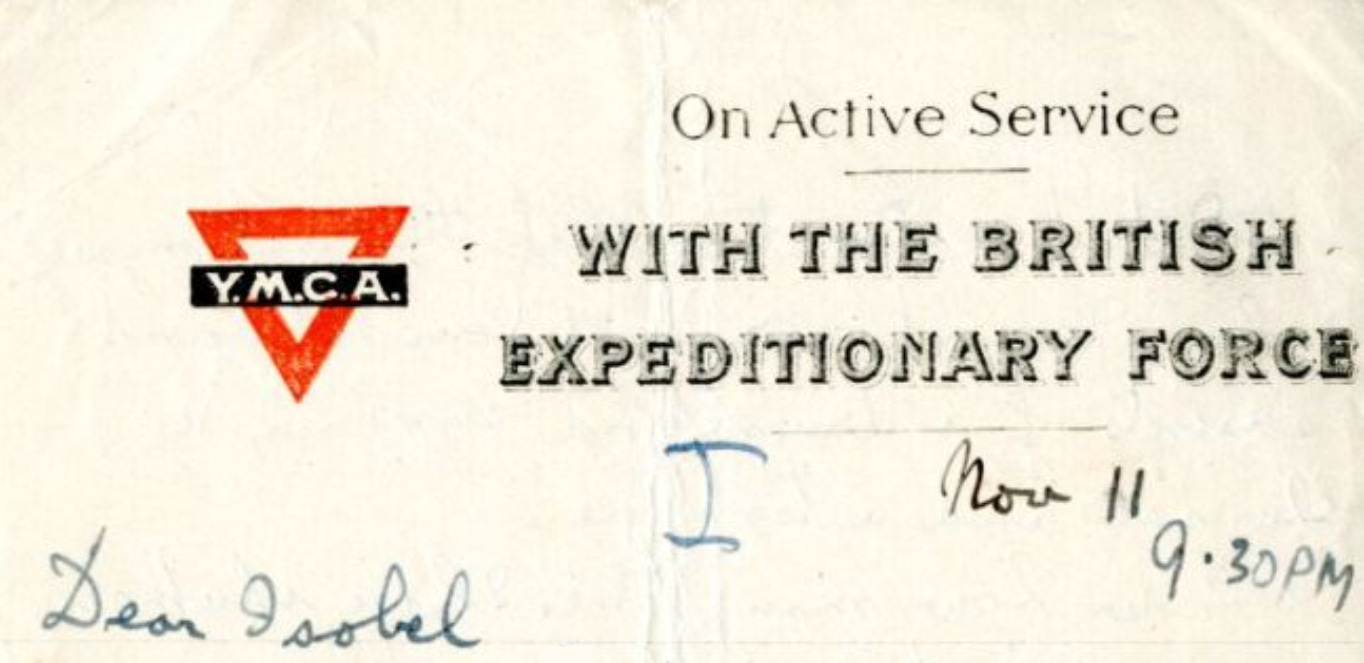
Despite the Armistice, and perhaps with the tune of Venus, bringer of peace, in mind, the work of the YMCA and of Holst went on. From the Brindisi canteen they served 60 sailors and 300 Serbian refugees, but Holst complained of the port city for its filth and theft. Fortunately, within days he sailed for Corfu and then on to Salonica to really begin his work.
Holst arrived into Salonica into a state described by his biographer Michael Short as a ‘disorganised and demoralised situation’, the soldiers weary with malaria, fever and flu. He was placed in Summer Hill Camp, where his friend and fellow composer Ralph Vaughan Williams had also served in 1916. He warned Holst that it was a ‘God-forsaken place’, the main base depot in the region.
But soon Holst was adjusting to the military way of life. He wrote to his wife during his first week in Salonica of his surprise at how often soldiers saluted him in his YMCA officers’ uniform, describing how once they recognised the triangle badge their manner would immediately soften, turning the salute into ‘a long handshake and we were pals at once’, such was the warm welcome the YMCA symbol encouraged. He enthused of how ‘we are constantly meeting the most interesting people’ among the British, French, Americans and Serbians all stationed in Salonica alongside the locals.
Holst worked at the YMCA hut at GHQ, under the leadership of Mr Ingles, a Scottish Presbyterian minister, who he described as having a ‘pawky humour [that] hides his deep sympathy and very wide learning and wisdom from all superficial people.’ The hut itself ‘has a canteen and theatre in one. Behind the stage there is an officers’ tea room which has two little dens leading out of it. Ingles sleeps in one and he has given me the other as a music room. It has a bed, two chairs, three tables and many shelves made of packing cases. I have been there every afternoon except one.’
The music room became Holst’s home in Salonica and he quickly wrote to his wife requesting sheet music for the troops. He gathered the Royal Artillery orchestra and led them in playing Mendelssohn’s Violin Concerto. Alongside performances, he also conducted lectures about music. One evening, he described giving a talk on the history of music as troops awaited transport, the men only visible by the lights at the end of their cigarettes. He also received a YMCA ‘Tin Lizzie’ Ford motor car, which was said to ‘go anywhere and everywhere’, making it possible to travel between camps.
Supply was a prominent issue in Salonica. While Holst was relieved that food was plentiful and wine cheap, music and instruments were in short supply, as were often the troops themselves. With the war over, demobilisation had begun and was being conducted in a sporadic fashion with men getting ‘demobilised at 5 minutes notice’, disrupting all plans he was trying to implement and meaning he had to ‘scour the country with my Lizzie to get others’.
But up against these constraints, Holst was still able to host large concerts for those remaining in Salonica. In February 1919 he held a concert in celebration of British music, with works by Purcell, Stanford and Elgar, performed with a choir of soldiers and nurses from 52nd General Hospital. There’s something of a personal quest within this, for he was keen to grow appreciation for British music alongside the great European works.
He was delighted with its success, writing to his wife Isobel, ‘All went well, happily and excitedly and we had a big and unexpected audience in the theatre and an equally big one outside. As the theatre is a canvas one the latter heard quite well … Never, never, have I seen such an audience. They sat on seats, on the ground, on petrol tins, on instrument cases (the double base one held five men and a dog) … Moreover so many people had to be refused that we were forced to repeat the concert last night.’
But despite waiting to long to find his place in the war effort, it is clear from Holst’s letters that he wasn’t a natural fit in the YMCA. By March he was questioning whether he wanted to continue to serve overseas or if the pull to return to teaching was too strong. He also worried that ‘I haven’t the time, opportunity, or inclination for composition. I discovered that the two essentials for me to write are silence and solitude neither of which I get here.’ Yet still his sense of duty was strong. He wanted to serve long enough that he could make some difference to military music: ‘what I hope to achieve if I stay on is to get so much musical work going that the army or the YMCA would feel compelled to keep it going when I left.’
Yet as 1919 wore on and the men around him demobilised, it is perhaps unsurprising that Holst felt drawn to return to normality and the teaching he felt called to. As Spring turned to Summer his letters shift in tone and there is a sense that he is on a final tour, savouring his time with the YMCA before travelling home.
And for a final tour he had an impressive lap of the Aegean region. First he travelled to Athens for leave over Easter, using the opportunity to celebrate Easter at the Greek Orthodox and Armenian churches, before attending the YMCA’s own.
He was then on to Constantinople, where Allied forces were overseeing the break up of the collapsed Ottoman Empire. Holst quickly described it as ‘much more thrilling than Salonica’, not least because ‘I’ve got some music to work with’, the men equipped with songbooks and sheet music for orchestras.
This was a tense time in the occupation of Constantinople with tensions among soldiers growing as the impatiently awaited demobilisation and struggled with the temptations of the Ottoman capital. Security was tightened and there was a feeling of restlessness, which was not conducive to attendance at the YMCA’s musical endeavours.
Yet Holst busied himself with a new mission. In the spirit of his Thaxted Whitsun festivals, he organised a music competition for the 7th June, followed by a concert that was to be repeated each night for a week. This became his farewell festival. Hosted at the YMCA Theatre des Petits-Champs on the Grand Rue de Pera (now Istiklal although the theatre doesn’t remain), Holst gathered all available musicians to perform. Committed again to proving British music’s worth, there were works by Purcell, Elgar and his friend Vaughan Williams, as well as music by Grainger and German.
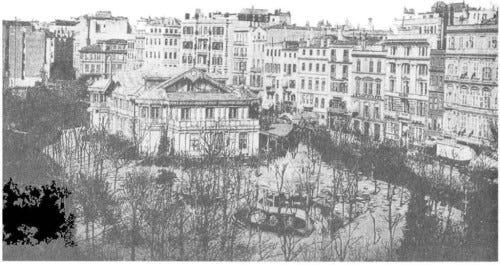
But most special of all was the inclusion of one of Holst’s own pieces. For the occasion he reworked ‘A Festival Chime’ under the title ‘A Chime for the Home-Coming’, showing what a celebration he saw this to be.
As ever, attendance at the concerts was hit and miss as men continued to be demobilised. Holst was particularly disappointed that the French contingent didn’t show to the competition, but the week went on celebrating the music of the soldiers.
By the end of it, and on a ship heading back towards Italy, Holst took the time to reflect to his wife that it was a success, despite the limited audiences at some performances, and that it had made a ‘deep impression on many, especially the choir, and that is the main point.’
The farewell concerts in Constantinople were perhaps the greatest testament to Holst’s war work. Like much of his service it was him trying his best to organise and bring soldiers together, to celebrate music, and provide a distraction from military life, even amid the confusion and disorganisation of demobilising occupying forces.
He did his part and volunteered his immense talents, but ultimately realised that his greatest service was what he had already been doing. Upon landing back in England he immediately visited St Paul’s Girls School, the Royal College of Music and Morley College, reacquainting himself with his own world and returning to his passion.
He then caught the train home to his beloved Thaxted and to his family, recommitting himself to composition and teaching. Yet his life was soon to change entirely. The fame of The Planets quickly took off, bolstered by Holst setting Cecil Spring Rice’s poem ‘I Vow to thee, my Country’ to music in 1921. The tune was adapted from ‘Jupiter’ and was given the name ‘Thaxted’ after his beloved village home. It would become an ingrained part of remembrance ceremonies, Holst’s own service with the YMCA no doubt resonating in his mind as he worked.
Kathryn
Sources:
Holst’s letters and documents are archived in the Britten Pears catalogue: https://www.bpacatalogue.org/
Michael Short, Gustav Holst: The Man and his Music, https://archive.org/details/gustavholstmanhi0000shor
Imogen Holst, The Music of Gustav Holst, https://archive.org/details/gustavholstmanhi0000shor/page/176/mode/2up
The letters of Vaughan Williams: https://vaughanwilliamsfoundation.org/letter/letter-from-ralph-vaughan-williams-to-gustav-holst-25/
The Red Triangle journal of the YMCA